
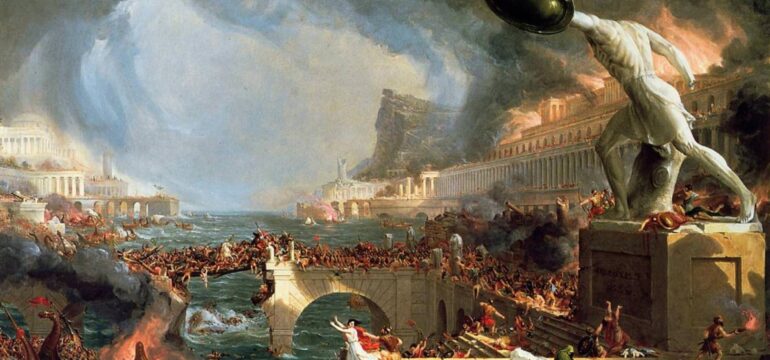

Recently, I read Emily Wilson’ scathing review of Christopher Nolan’s adaptation of The Odyssey (2026) in the London Review of Books, one which felt refreshing in a sea of bad-faith right wing takedowns of the film—including those of the wealthiest man in the world, who apparently has nothing better to do—which scarcely imply any engagement with the actual film, much less the source material. Wilson is, of course, one of the foremost Homeric scholars, one who has authored wildly popular translations of both The Iliad and The Odyssey which are genuinely novel in their devotion to maintaining both the vernacular meanings of the original text and their poetic meters, a feature most previous translations abandon in favor of prose.
While I appreciate that Wilson’s criticisms arise from a place of familiarity with the text, my thoughts on the actual issues she takes with Nolan’s reinterpretation are more complicated. On some accounts, I think her grievances are spot-on. I share Wilson’s frustration that, despite the film’s diverse cast, the characters with the most agency are ultimately white men. I too am upset that the film was shot in the occupied Western Sahara, which certainly complicates the film’s own critiques of colonial violence. However, where I depart from Wilson’s view is in her marked distaste for the adaptational changes Nolan brought to his film; her disappointment that “there are no sex scenes,” that Damon’s Odysseus “seems to lack technological intelligence,” that the film’s values “directly contradict those of Homer’s poem.” Mind you, these are all factual statements about the film. Nolan’s film is not doing any of these things, but importantly, I don’t think it wants to.
Even if Wilson will admit that adaptations “needn’t and shouldn’t follow the original with anything like the exactitude of a translation,” I feel that her criticism of the kinds of changes Nolan made to Homer’s poem and the effects those changes have rubbed me the wrong way in no small part because I think they occasionally fail to engage with the goals that Nolan actually had in making those changes. With that, in this article I’d like to highlight some notable examples of how and why films choose to depart from their source materials and subsequently what those acts of unfaithfulness can add to a reading of the film that’s informed by its individual goals.
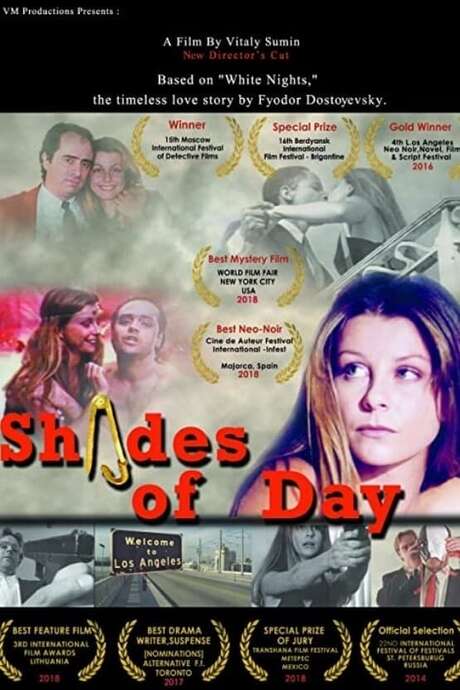
Shades of Day – New Director’s Cut (Vitaly Sumin, 2023)
One of the most common ways we see film adaptations stray from their source materials is through a change in location. Particularly when reworking novels from older and foreign authors, it makes sense that filmmakers would decide to set the events of the original work within a more local setting, sidestepping the need for extensive period set-dressing, language and vocal coaches, and the intricacies of authentically replicating cultures and society of which the entire cast and crew isn’t local. We see this done in films like Akira Kurosawa’s Ran (1985) and Baz Luhrmann’s Romeo + Juliet (1996), which both take works of Shakespeare and reimagine them hundreds of years and miles removed from the lands from which they came.
However, I’m not just interested in the utility of adaptational infidelity, I’m interested in its poetics. Take Vitaly Sumin’s Shades of Day, a remarkable adaptation of Fyodor Dostoyevsky’s novella White Nights (1848), and the first instalment of his larger “Dostoyevsky-L.A.” project. The film transposes the hyper-active first-person telling of a man who loves a woman who will never return his affections because of her attachment to another to a sprawling Los Angeles fable of love and jealousy including wild plot-threads not present in the original. It goes without saying that the cultures, customs, and even climates of late-1840s Saint Petersburg and mid-2000s L.A. are worlds apart, a shift which fundamentally changes the context through which the events of the narrative transpire. While the film is no less psychologically driven than Dostoyevsky’s text, said psychology is developed further by casting the originally nameless narrator as white police officer Steven Prescott and his love interest’s amour as Paul, a well-to-do black man. This allows the film to use the original novella as a way of sub-textually grappling with white America’s history of insecurity regarding racist notions of black sexuality through its adaptational changes, not even regarding the many other expansions Sumin applies to the narrative.
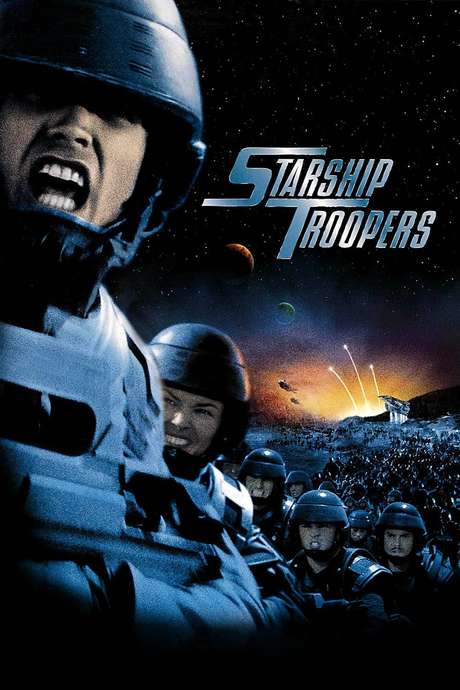
Starship Troopers (Paul Verhoeven, 1997)
Some films are not simply satisfied to transpose the plots and themes of texts to new contexts, instead interested in changing them in ways that actively grapple with the original. In the same way that an essayist can emphasize the words of a thinker they disagree with to highlight their hypocrisies, so too can the skilled filmmaker do so in the process of adaptation. We see this done in films like the Zucker Brothers’ Airplane! (1980) and Spike Jonze’s Adaptation (2000), which are equal parts original statements and commentaries on the movie and book they are adapting respectively.
Of course, no discussion of the self-reflective adaptation I’ve described is complete without mentioning Paul Verhoeven’s Starship Troopers, a film which uses the names and likenesses of Robert Heinlein’s original techno-fascist tale of killing alien bug creatures and its broader narrative strokes, but through the over-the-top, gory lens of 80s Verhoeven. There is no way to read this film without the context of the director’s early childhood experience in Nazi-occupied Holland and his subsequent early career forays into anti-fascist cinema, one which is positively tactile in his adaptation. By stripping Heinlein’s text of the elegant, technical, borderline fetishistic prose which glamorized his ideal future of all-but-mandatory military service towards the aims of human supremacy, Verhoeven is using the skeleton of Starship Troopers as a way of skewering the novel and the ideology it promotes through raucous parody.
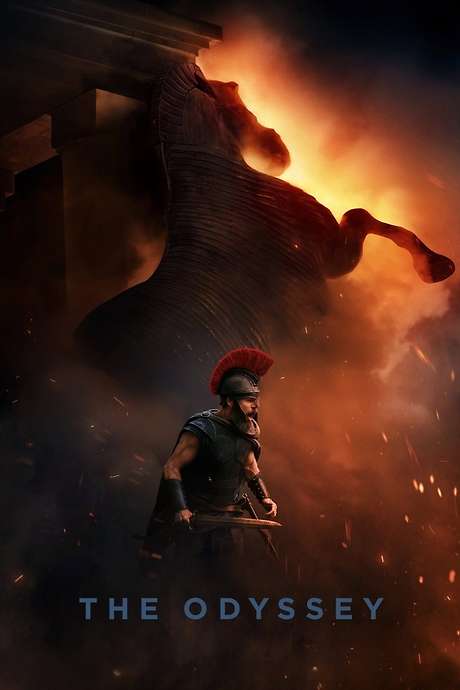
The Odyssey (Christopher Nolan, 2026)
More common than the self-reflective kinds of adaptation in a work like Verhoeven’s—likely because it can’t be an easy sell to the rightsholders to say hey, I don’t want people to want to read your book or watch your movie after they watch this—is the unfaithful adaptation that is really only interested in the source material as a vehicle to tell a new story with new ideas. Sometimes, the most interesting ideas one takes from a text aren’t the ones it offers, but rather the ones created through the synthesis of the story’s themes and the pre-existing worldviews of its readers. In examples like Stanley Kubrick’s The Shining (1980) and Orson Welles’ Chimes at Midnight (1965), the general characters and narrative architectures of the originals stay the same, but still leave completely different impressions on the viewer than their source material due to their substantial deviations.
Returning to the film which sparked this article, I think that Nolan’s The Odyssey offers a helpful look at how ostensibly unfaithful adaptations can use the frameworks built by the original texts to tell new stories with new goals. The film is one interested in questions of storytelling and faith, one where the main character is only ever able to tell the truth through the lens of lies, fables, and misremembrances. In it, the Gods are all but absent, with the only one on-screen being an Athena who can only ever be seen by Odysseus, but when questioned as to why they do not make themselves more obvious to humans, we are questioned as to why storms, earthquakes, and the smiles of children do not count as manifestations of the divine. In this, Nolan puts forward a version of the poem where the factual reality of divinity is put into question and the nature of magic is suspect—Odysseus is the only character in the film from whom we ever hear tales of the supernatural—but finds its value in that it is able to describe what lies underneath the disguises of human skin. It’s a film where the material reality presented by exteriors are systematically pulled away to reveal the often ugly truths that we can only imagine through metaphor: the menacing suit of armor which cloaks a coward, monsters which make palatable the intentions of cruel men, the pristine wooden horse which contains a betrayal of human dignity so great that it necessitates the collapse of the civilization that built it. These are, in my opinion, the goals of The Odyssey, and what I believe makes it an exciting adaptation are the ways it achieves those goals because of its infidelity to Homer, not despite it.
Conclusion
I do not want any of this to come off as some sort of takedown of the credibility of Emily Wilson as a critic or scholar, a task which I am by no means in the position to do, nor even interested in—ultimately, my disagreement with Wilson’s criticism is rooted in what I see as perhaps a less good-faith reading of the purposes behind Nolan’s departures from Homer’s poem than my own, which is not a sin. Rather, I wanted to argue that in works like Sumin’s Shades of Day, Verhoeven’s Starship Troopers, and Nolan’s The Odyssey, we’re presented with a compelling case for the value of a more charitable, goal-oriented approach to evaluating film adaptations. When watching these films, don’t just ask yourself how authentic they are to the events of the source material, which characters are being left out, or which themes the filmmakers changed. Rather, I would implore you to wrestle with perhaps a more empathetic set of questions: what does this film want to say about the place it’s reimagining the source material? About the work that it is adapting? About a world which perhaps didn’t even occur to the original author?
Want to know about VMP Films and about the films we make? Want to participate in our projects? Go to www.dostoevsky-bts.com and enter your email on the box at the bottom of the page where it reads “I Want To Be Part Of The Action!” and you are ready to go. Don’t forget to grab our FREE e-books!
Before you go, free to check us out on Twitter, Instagram, Facebook, Pinterest, and Goodreads!









Leave a Reply